


Sleep Cooler Tonight: Fabrics for Night Sweats, Linen, Lyocell, Hemp
Lyocell, linen, hemp, bamboo viscose, and lightweight cotton percale outperform most other options for night sweats because they combine an open weave with real moisture management, not just a soft name on a label. The rule that matters more than any fiber name: pick breathable construction (a low to moderate thread count, an open weave, sensible fabric weight) paired with a fiber or finish that actually moves moisture. Fabric will not stop hormonal or medical night sweats, so if yours are new, severe, or worsening, talk to a clinician before you shop.
TL;DR:
- Linen and lyocell are the most effective fabrics for night sweat management due to their open weaves and superior moisture transfer.
- Fabrics with higher thread counts and denser weaves, such as sateen, trap heat and reduce breathability, making them less suitable for hot sleepers.
- Construction features like lightweight GSM and loose weaves enhance airflow and moisture evaporation, regardless of fiber type.
- Proper layering, including breathable sheets and light blankets, optimizes moisture control without trapping heat, especially when sheets are fitted correctly.
- Fabric softeners and improper care can impair moisture-wicking properties, so gentle washing and avoiding chemical residues are essential.
Table of Contents
- Which Fabrics Handle Night Sweats Best?
- Wicking vs. Absorbent Fabrics: Why the Difference Matters
- What Should You Upgrade First: Sheets, Pillowcase, or Pajamas?
- What to Check Before You Buy: A Shopping Checklist
- How Do You Wash Fabrics Without Killing Their Breathability?
- Why Breevar’s Take on Fabric Comes From Hands-On Experience
- Fabric Manages Comfort, Not the Underlying Cause
- Try Breevar’s Linen and Hemp Sleepwear Built for Hot Sleepers
- Sources
- FAQ
Which Fabrics Handle Night Sweats Best?
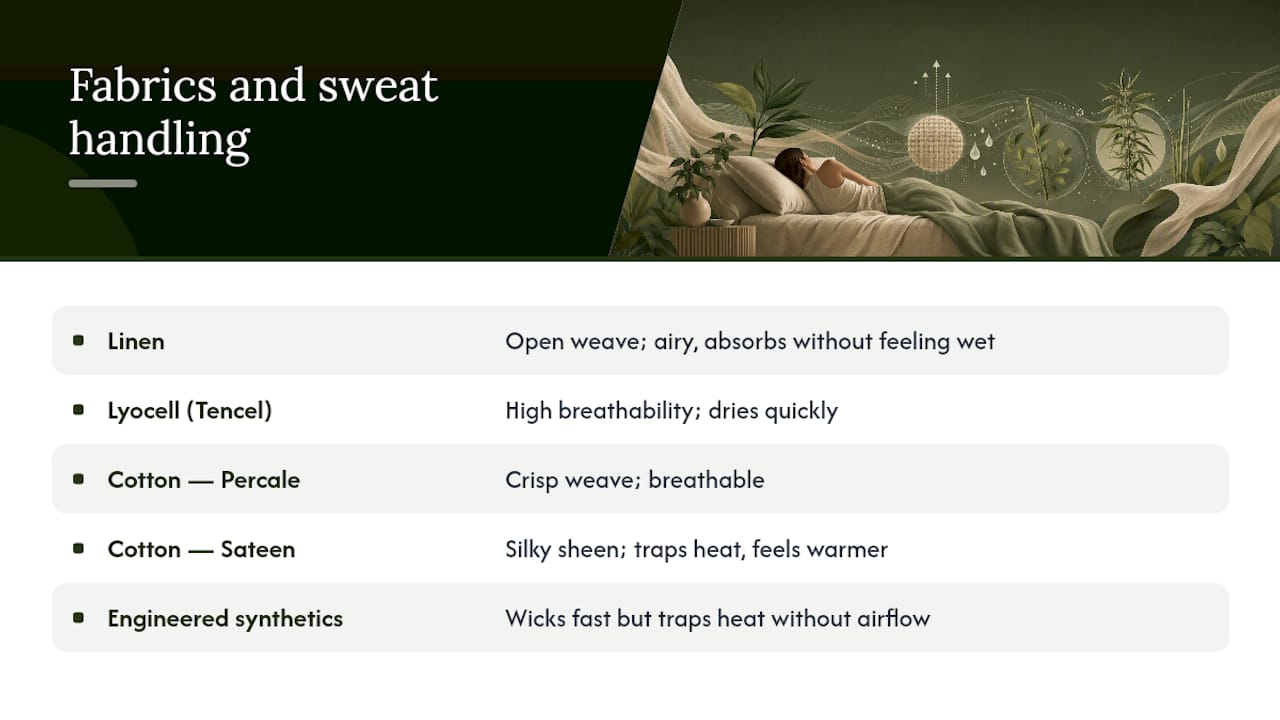
Not every “cooling” fabric behaves the same way once real sweat hits it. Some fibers pull liquid away from skin and let it evaporate fast; others just soak it up and hold onto it until morning. Here’s how the main contenders actually perform.
Linen is a genuine standout. Its long flax fibers create a naturally open weave that moves air freely, and linen absorbs moisture without feeling wet against skin the way cotton sateen can. The trade-off is texture: linen wrinkles fast and has a slightly rougher hand than modal or lyocell, though it softens with every wash. It works well in both sheets and sleepwear.
Lyocell (often sold as Tencel) is a regenerated cellulose fiber made from wood pulp, and lab testing on bed microclimates shows lyocell and viscose blends often post higher breathability and liquid transfer than standard cotton. It feels silky, drapes well, and dries quickly, making it a strong pick for sheets and lightweight sleepwear alike.
Bamboo viscose gets marketed as a miracle fiber, but the Federal Trade Commission has flagged this repeatedly: most “bamboo” bedding is actually viscose or rayon processed from bamboo pulp, which means it shares the same fiber level properties as any other regenerated cellulose. It is soft and breathable, but it also demands more careful laundering than people expect.
Cotton splits into two very different sleep experiences depending on weave. Percale, woven in a simple crisscross pattern, feels crisp and lets air pass through. Sateen, woven with more threads floating on the surface for a silky sheen, traps heat and feels warmer against skin.
Modal, another cellulose fiber, sits between cotton and lyocell: soft, stretchy, decent moisture handling, but slightly less breathable than an open linen weave.
Wool and merino sound counterintuitive for hot sleepers, but a polysomnography study found wool sleepwear shortened sleep onset at 17°C compared with cotton, thanks to its natural moisture buffering. That advantage shows up mainly in cooler bedrooms, not sweltering ones.
Engineered synthetics (polyester or nylon wicking blends) move moisture fast through capillary action but trap heat against skin once airflow stops, which is exactly the problem for someone already overheating.
Wicking vs. Absorbent Fabrics: Why the Difference Matters
A fabric that “wicks” pulls sweat away from skin through capillary action and spreads it across a wider surface so it can evaporate. An absorbent fabric, by contrast, just soaks liquid up and holds it, which feels fine for the first few minutes and clammy an hour later. The catch: wicking only cools you down if air can actually reach the fabric and carry the moisture away. A wicking sheet trapped under a heavy comforter with zero airflow does almost nothing.
Construction decides most of this, arguably more than the fiber name on the tag:
- Weave type. Percale (plain weave) breathes better than sateen (satin weave) because it has fewer threads packed per square inch on the surface.
- Thread count. For percale, aim for 200 to 400. Anything much higher usually means a denser weave that blocks airflow, whatever marketing copy claims.
- Fabric weight (GSM). Where listed, lighter grams per square meter generally means better airflow for hot sleepers, while higher GSM favors warmth and insulation.
- Fit. A loose weave in a snug garment still traps heat against skin, so garment cut matters almost as much as the textile itself.
A systematic review of sleepwear and bedding fiber types found that construction and fiber together affect sleep quality, but the studies vary enough that no single fabric works identically for every sleeper. Watch out for fabric softeners and finishing chemicals too. Softener coats fibers with a waxy residue that blocks the wicking a fabric was built to do, even on a technically “moisture wicking” label.
What Should You Upgrade First: Sheets, Pillowcase, or Pajamas?
Start with the sheet and pillowcase, since that’s the layer in direct, sustained contact with skin all night. Sleepwear comes second, and duvet or comforter weight comes last, since a heavy topper can undo everything underneath it regardless of what’s touching your skin.
Layering beats a single heavy blanket for anyone dealing with night sweats:
- A lightweight, breathable sheet (linen or cotton percale) as the base layer.
- A thin blanket you can kick off mid-sleep without disturbing a whole duvet system.
- An adjustable duvet or comforter you can swap by season instead of one heavy year-round cover.
One overlooked detail: a fitted sheet that bunches, rides up, or detaches from the mattress corners negates any wicking benefit, as it exposes you to a mattress pad or protector not designed for moisture management. For sleepwear, target the same fiber logic. Look for breathable sleepwear built from linen, hemp, or lyocell rather than a synthetic “cooling” blend that only performs when there’s airflow to spare.
What to Check Before You Buy: A Shopping Checklist
Reading a product listing for cooling bedding or sleepwear gets confusing fast, mostly because brands lean on vague words like “breathable” without backing them up with specs. Here’s what actually tells you something.
| What to check | What you’re looking for | Why it matters |
|---|---|---|
| Fiber content | Linen, hemp, lyocell, bamboo viscose, cotton percale | Determines base moisture behavior and hand feel |
| Weave | Percale or open weave, not sateen | Sateen traps heat against skin |
| Thread count | 200 to 400 for percale | Higher counts often mean denser, less breathable fabric |
| Fabric weight (GSM) | Lower GSM where listed, for hot sleepers | Lighter fabric generally moves air more freely |
| Label language | “Lyocell” or “viscose” specifically | Bamboo claims often just mean bamboo derived viscose |
| Care instructions | Machine washable, no fabric softener needed | Signals the finish won’t need harsh stripping later |
If a listing skips weave or thread count entirely, that’s worth a message to customer service before you buy, especially for sleepwear where fit affects airflow as much as fiber. Ask directly for GSM or weave details if the product page doesn’t list them.
For sleepwear fit, loose and lightweight beats fitted and heavier fabric every time for a hot sleeper. A relaxed cut lets air circulate around skin instead of trapping heat the way a snug t-shirt or fitted pajama top does.
Pro Tip: Buy two sets of sheets or two pairs of pajamas in your chosen fabric and rotate them. Natural fibers absorb more moisture than synthetics but also take longer to fully dry, so a single expensive set often leaves you sleeping on damp fabric more nights than you’d expect.
How Do You Wash Fabrics Without Killing Their Breathability?
Skip the fabric softener and dryer sheets entirely. Both coat fibers in a waxy film that blocks the airflow and moisture transfer you paid extra for. A gentle detergent and a moderate wash temperature protect the fiber structure far better over time.
- Linen and hemp hold up to regular machine washing and actually soften with each cycle, so don’t baby them.
- Lyocell prefers a gentler cycle and lower heat, since high heat can shorten its fiber life faster than cotton.
- Always dry fabric fully before storing or reusing it. Damp storage invites mildew and undoes the wicking benefit entirely.
- Keep two sets in rotation so one is always clean and completely dry while the other is in use.
Pro Tip: If you only have one set of sheets, wash them earlier in the day rather than at night, so they have a full day to air dry completely before you need them again.
Why Breevar’s Take on Fabric Comes From Hands-On Experience
This guidance comes from Jason, writing for Breevar, a brand built specifically around hemp and linen sleepwear for people who overheat at night. That focus means testing fabric performance and reading customer feedback isn’t theoretical here; it’s the daily work. Breevar’s own reporting on breathable sleepwear and choosing the right sleepwear informs the specific recommendations above.
Fabric Manages Comfort, Not the Underlying Cause
Fabric changes reduce discomfort by keeping skin drier and preserving airflow, but they don’t address why the sweating happens. Sleep Foundation and Mayo Clinic both frame fabric choice as comfort management, not treatment. See a clinician if sweats are new, drenching, or paired with fever, weight loss, or pain. Pair fabric swaps with a cooler thermostat setting and adjustable layers for the best results.
— Jason
Try Breevar’s Linen and Hemp Sleepwear Built for Hot Sleepers
Some brands offer natural, breathable sleepwear aligned with this guide’s recommendations, sometimes supporting nonprofit climate action work, blending comfort with ethical priorities.
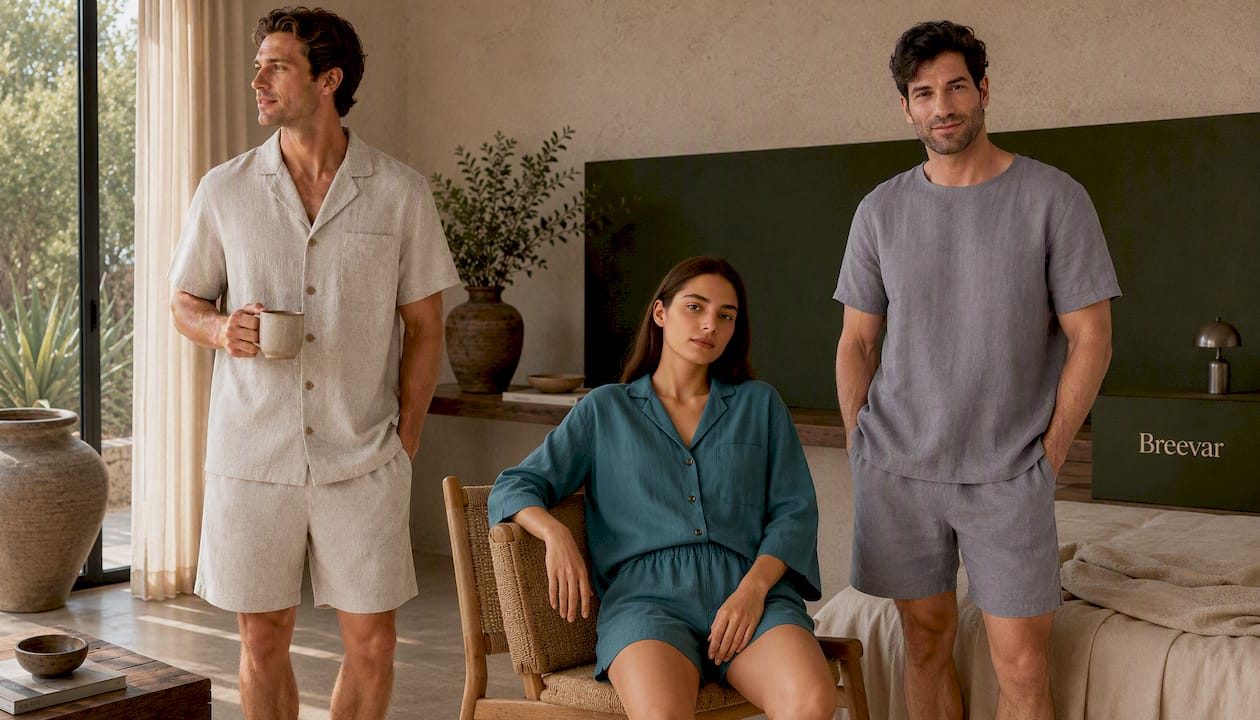
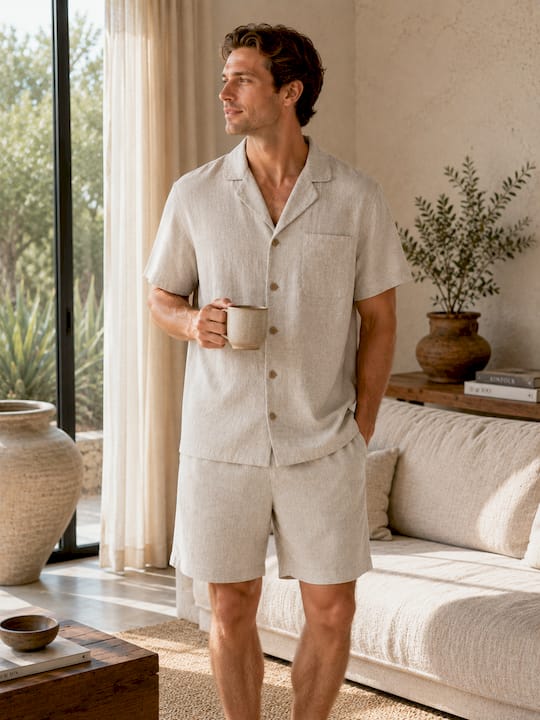
The Men’s Short-Sleeve Linen Sleepwear uses a lightweight linen weave built for airflow, matching the open construction this guide recommends over dense sateen. The Women’s Linen Sleepwear follows the same logic in a relaxed cut designed not to trap heat against skin overnight. For sleepers who want an even more breathable natural fiber, the Men’s Short-Sleeve Hemp Sleepwear Set delivers hemp’s naturally moisture-managing structure in a lightweight short-sleeve set.
Browse the full men’s sleepwear and women’s sleepwear collections, or shop hemp sleepwear and linen sleepwear by fiber. Breevar also carries breathable underwear and socks, plus a text monogram option for gift sets. If a product page doesn’t list the exact GSM or weave you’re comparing against, reach out to customer service directly, then pick two sets and start rotating them tonight.
Sources
- Sleep Foundation: Night sweats
- The effects of fabric for sleepwear and bedding on sleep at ambient temperatures of 17°C and 22°C
- Mayo Clinic: Night sweats causes
- FTC: Bamboo fabrics
FAQ
What Is the Best Fabric for Night Sweats?
Linen, lyocell (Tencel), hemp, and lightweight cotton percale perform best because they combine an open, breathable weave with genuine moisture movement. No single fiber works for everyone, since a systematic review of sleepwear studies found results vary by construction and by the sleeper’s own environment.
What Naturally Helps Reduce Night Sweats?
Cooling your bedroom, wearing loose and lightweight natural fabrics, and swapping heavy bedding for adjustable layers all help manage the discomfort of night sweats. None of these fix an underlying hormonal or medical cause, so Mayo Clinic recommends evaluation if sweats are new or severe.
What Is the Best Fabric for People Who Sweat Heavily?
Linen and lyocell tend to handle heavy sweating best because their open weaves allow both liquid movement and evaporation, unlike absorbent fabrics that hold moisture against skin. Breevar’s hemp sleepwear and linen sleepwear collections are built around this same principle.
What Hormone Deficiency Causes Night Sweats?
Declining estrogen during perimenopause and menopause is the most common hormonal driver of night sweats, though thyroid changes and other hormonal shifts can also play a role. Because causes vary widely, Sleep Foundation notes that persistent or severe cases deserve a clinical evaluation rather than a fabric fix alone.


Leave a comment