


Shop Hemp Fabric Like an Eco Buyer: Spot Mechanical vs Hemp Viscose
Hemp fabric is a textile woven from the bast fibers inside the stalk of Cannabis sativa. When those fibers are mechanically processed, the result is a low-impact, durable, breathable material. When they’re chemically dissolved into hemp viscose, the fabric carries the same footprint as any other regenerated cellulose fiber. It shows up most often in sleepwear, socks, bedding, and casual apparel.
TL;DR:
- Mechanically processed hemp fabric offers higher strength and durability than cotton, lasting longer with less pilling or tearing over time.
- Hemp’s environmental benefits are maximized when processed mechanically, as chemical regeneration like viscose negates its low-impact advantages.
- The cost of textile-grade hemp varies, with mechanically processed, certified fabrics typically costing more than blends or regenerated fibers due to limited supply and specialized processing.
- Hemp’s natural properties, including moisture-wicking, antimicrobial activity, and UV resistance, make it particularly suitable for sleepwear, socks, and home textiles.
- Hemp fabric’s coarser feel out of the package softens with washing, and limited availability may impact selection and pricing for buyers seeking immediate softness or specific styling.
Table of Contents
- What Is Hemp Fabric, Exactly? Botanical and Material Basics
- How Hemp Fabric Is Made: From Field to Fiber
- Hemp Fabric’s Properties: Strength, Breathability, and Care
- What Hemp Fabric Is Used For
- Is Hemp Fabric Sustainable? The Evidence and the Catch
- Decoding Hemp Fabric Labels and Certifications
- Where Hemp Fabric Comes From and What Drives the Price
- Where Hemp Fabric Still Falls Short
- Breevar’s Take on Hemp in Sleepwear
- Try Breevar’s Hemp Sleepwear and Socks
- Sources
- FAQ
What Is Hemp Fabric, Exactly? Botanical and Material Basics
Hemp fabric comes from industrial hemp, a variety of Cannabis sativa L. bred for fiber and grain rather than for the compounds found in recreational cannabis. In the United States, industrial hemp is legally defined by its low tetrahydrocannabinol (THC) content, which keeps it in an entirely separate regulatory category from marijuana. That distinction matters for growers and processors, but it has nothing to do with how the fabric feels or performs on your skin.
The stalk itself has two usable parts. The outer layer contains long, strong strands called bast fibers, which get spun into yarn and woven into textiles. The woody inner core, called hurd, gets used for things like paper, animal bedding, and construction material such as hempcrete. Only the bast fiber matters when you’re shopping for fabric.
Hemp belongs to the same bast fiber family as flax, the plant behind linen. Both fibers come from the plant stem, both are prized for strength, and both have that slightly crisp hand feel before they’re softened through washing or specialized processing.
- Bast fiber: the long, strong strands harvested from the stalk’s outer layer
- Hurd: the woody core, used in paper and building materials, not textiles
- Industrial hemp: legally distinct from marijuana due to low THC content
- Closest fiber relative: flax, the source of linen
How Hemp Fabric Is Made: From Field to Fiber
Hemp plants are sown densely and harvested before they go to seed, which keeps the stalks tall, straight, and fiber-rich. What happens after harvest determines almost everything about the final textile, from softness to environmental cost.
The first step is retting, a controlled rotting process that loosens the bast fibers from the woody core. A peer-reviewed review of hemp fiber processing identifies retting method, alongside decortication, as the primary factor separating high-quality textile hemp from coarse industrial fiber. Three retting methods dominate:
- Dew retting — stalks are left in the field for weeks, relying on ambient moisture and microbes. Low water use, but weather-dependent and less consistent.
- Water retting — stalks are submerged in tanks or ponds. Faster and more uniform, but water-intensive and can create wastewater issues if not managed.
- Enzymatic retting — controlled enzyme baths speed the process and improve consistency, making it a favorite for scaling textile-grade output.
From there, two very different paths emerge. The mechanical route runs fiber through decortication, scutching, and hackling to separate and align it, then spins it into yarn using conventional or cotton-adapted spinning systems. The chemical route dissolves the same raw fiber in a solvent, most commonly carbon disulfide in the viscose process, and regenerates it into a cellulose filament. Some producers use closed-loop lyocell methods instead, which recover more solvent, but standard hemp viscose still carries the environmental baggage of any regenerated cellulose fiber, regardless of the plant it started from.
Pro Tip: If a label says “hemp viscose” or “hemp rayon,” you’re looking at a chemically regenerated fiber, not mechanically processed hemp. The two behave and impact the planet very differently.
Hemp Fabric’s Properties: Strength, Breathability, and Care
Hemp is one of the strongest natural fibers available. Textile Exchange notes that hemp outperforms cotton on tensile strength, which translates into garments and sheets that resist tearing and pilling over years of use, not months.
That strength pairs with genuine breathability. Hemp’s fiber structure wicks moisture away from skin efficiently, which is why it shows up so often in sleepwear and undergarments for people who run hot at night. The same technical review of hemp fiber points to natural antimicrobial and antifungal activity, plus UV-resistance tied to the fiber’s lignin content. That combination helps explain why hemp textiles tend to resist odor buildup better than synthetic alternatives.
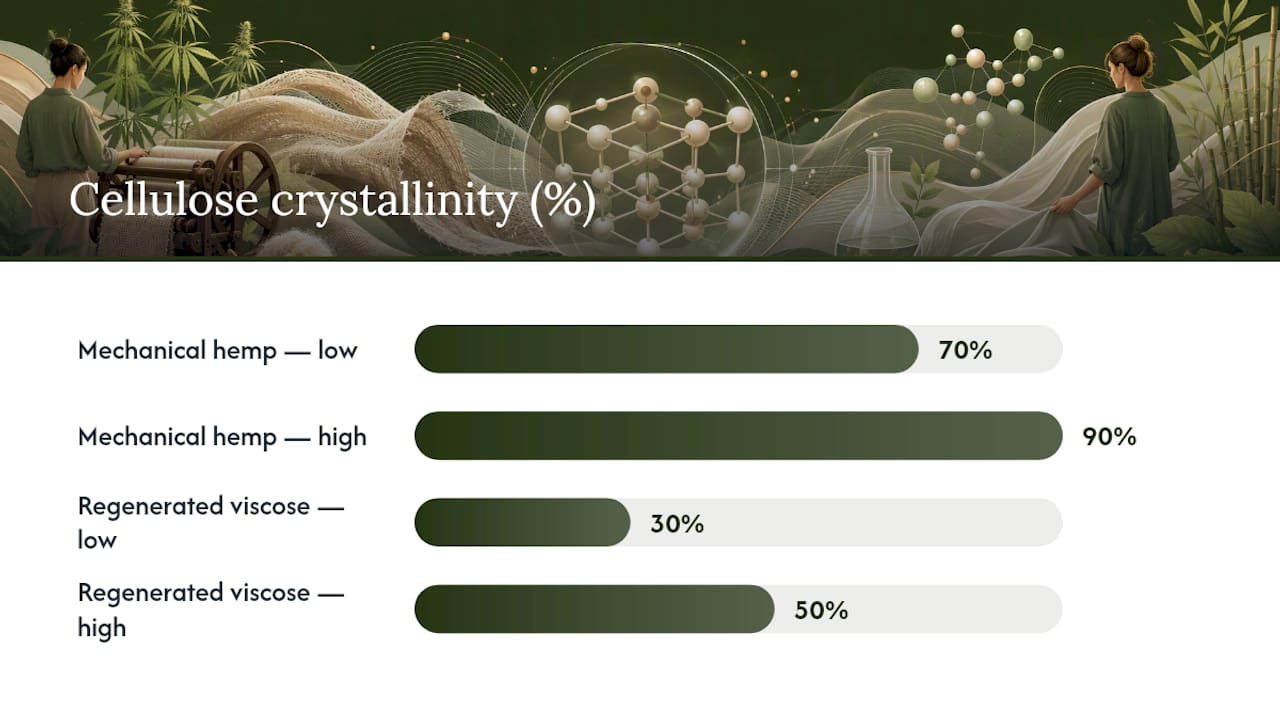
A quick numbers check: mechanically processed hemp retains 70–90% cellulose crystallinity, according to industry LCA data, compared to just 30–50% in regenerated viscose. Higher crystallinity means more strength and less shrinkage in the wash.
- Strength: outperforms cotton on tensile durability
- Breathability: wicks moisture, suited to sleepwear and undergarments
- Antimicrobial and UV-resistant properties linked to lignin content
- Texture: starts crisp, softens noticeably with repeated washing
- Care: mechanically processed hemp holds shape well; regenerated hemp viscose can shrink more
Raw hemp fiber has a reputation for feeling stiff, but that’s largely outdated. Cottonization techniques and enzymatic retting now produce softer, finer fibers that spin on standard cotton equipment, closing much of the comfort gap for next-to-skin garments.
What Hemp Fabric Is Used For
Hemp’s blend of strength and breathability makes it useful well beyond a single product category.
- Apparel: t-shirts, sleepwear, socks, and underwear, especially where moisture control and durability matter more than stretch
- Home textiles: sheets, towels, and curtains, where hemp’s breathability and long fiber life pay off over years of laundering
- Technical uses: composites, hempcrete, and insulation, built from the hurd rather than the bast fiber, proving the plant’s versatility beyond textiles
- Blends: hemp mixed with cotton, modal, or spandex improves drape and stretch when 100% hemp would feel too structured
A hemp and modal blend, for instance, keeps the moisture-wicking benefit while softening the drape for a t-shirt or a fitted sleep top.
Is Hemp Fabric Sustainable? The Evidence and the Catch
Hemp earns its sustainability reputation during the growing phase. The plant needs less irrigation than cotton in most growing regions, improves soil structure through its root system, and pulls a meaningful amount of carbon out of the atmosphere as it grows. One estimate puts hemp’s carbon sequestration at a meaningful amount of carbon dioxide absorbed per tonne of dry matter produced under favorable agronomic conditions.
That’s the good news. The catch is what happens after harvest.
- Mechanical processing keeps hemp’s low-impact story intact. Published LCA ranges put mechanically processed hemp at roughly 300–700 liters of water and 1.5–2.5 kg of CO2 equivalent per kilogram of fiber.
- Chemical regeneration erases that advantage. Hemp viscose runs closer to 2,000–3,000 liters of water and 3–5 kg of CO2 equivalent per kilogram, essentially matching any other viscose fiber regardless of the plant it started as.
- Scale risk is real. Textile Exchange warns that without industry-wide preferred standards, growing demand for hemp could push farming toward conventional, high-input methods that erode the crop’s natural advantages.
- Blending trade-offs matter at end of life. A shirt blended with polyester or spandex biodegrades far more slowly than a 100% hemp garment, even if the blend feels nicer to wear.
Pro Tip: Don’t assume “natural” automatically means “low-impact.” A product can be 100% plant-derived and still carry a heavy chemical footprint if it went through the viscose process. Always check how the fiber was extracted, not just what plant it came from.
For shoppers, the practical checklist is short: look for an explicit mention of mechanical processing, check for GOTS or OCS certification, and be wary of vague “eco-friendly” claims with no fiber declaration behind them.
Decoding Hemp Fabric Labels and Certifications
Label wording carries real legal weight. Under FTC textile rules, fiber that’s been chemically dissolved and regenerated must be labeled “rayon” or “viscose,” even when hemp was the starting material. A shirt marketed loosely as “hemp” on the hangtag but labeled “viscose from hemp” on the care tag is telling you exactly which process it went through.
- 100% hemp: mechanically processed, retains the fiber’s original structure
- Hemp viscose or hemp rayon: chemically regenerated, carries viscose-level impacts regardless of marketing language
- Hemp lyocell: a closed-loop solvent process that recovers more chemicals than standard viscose, though still a regenerated fiber
- GOTS and OCS certifications: verify organic status and chain-of-custody claims, though neither certifies processing pathway specifically
- Ask the seller: a legitimate brand will tell you whether its hemp is mechanically processed or regenerated if you ask directly
Where Hemp Fabric Comes From and What Drives the Price
Most textile-grade hemp spinning and finishing happens in China, India, Portugal, and Turkey, where mills have invested in the specialized equipment mechanical processing requires. Fewer facilities handle high-quality mechanical extraction than handle standard cotton or synthetic fiber, which keeps supply tighter than demand in some seasons.
- Mechanically processed, certified hemp typically costs more than blended or regenerated alternatives
- Certification (GOTS, OCS) adds cost but verifies the supply chain claims on the label
- Blended fabrics often run cheaper than 100% hemp due to easier sourcing and processing
- Finishing quality, like enzymatic softening, adds cost but improves next-to-skin comfort
It may be a hemp blend or a regenerated fiber priced to compete with cotton.
Where Hemp Fabric Still Falls Short
Hemp isn’t a perfect substitute for cotton or synthetic fabric in every situation, and pretending otherwise does readers a disservice.
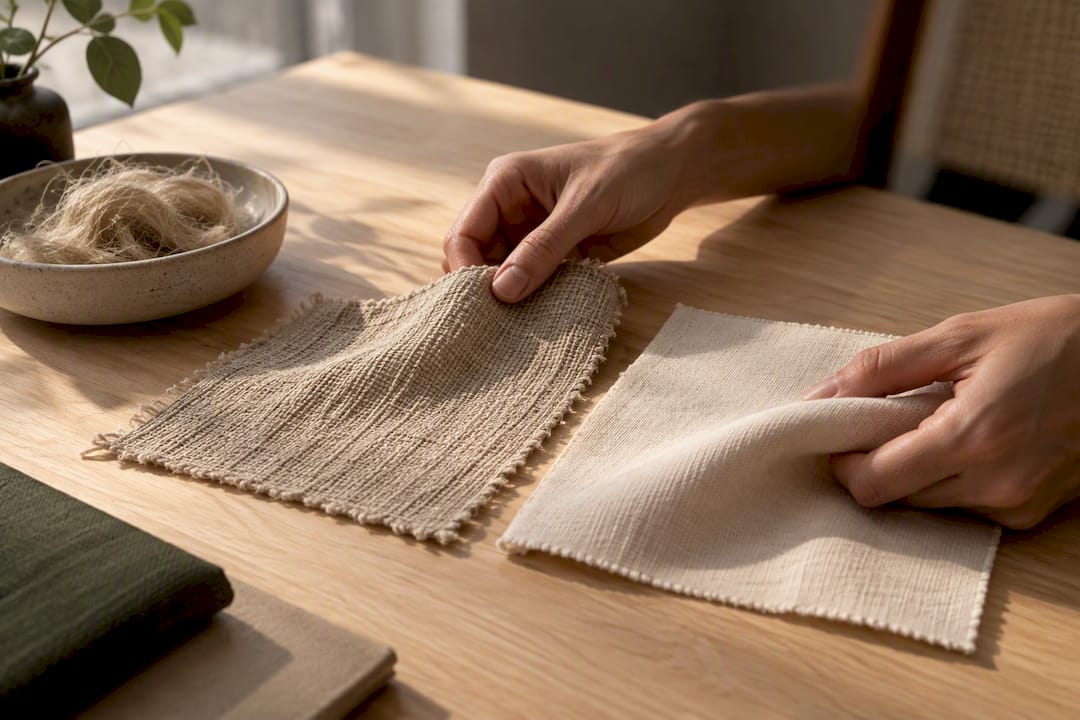
Raw, mechanically processed hemp can still feel coarser than combed cotton straight out of the package, even with modern cottonization techniques. It softens meaningfully with washing, but if you need immediate, buttery softness on day one, that adjustment period is worth knowing about upfront.
Availability is another real constraint. Because fewer mills specialize in mechanical hemp processing compared to cotton, product selection is narrower and restocks can take longer, particularly for specific colors or sizes. That supply bottleneck is also why prices sit higher than mass-market cotton basics.
Processing complexity adds a layer of buyer confusion. Because both mechanically processed hemp and hemp viscose can appear on a rack labeled simply “hemp,” shoppers have to read fiber content tags carefully to know which one they’re actually buying. That’s not a flaw in the fiber itself, but it is a real friction point in the shopping experience.
Hemp also doesn’t stretch the way spandex-blended fabrics do, so garments built for a snug, flexible fit usually need a blend rather than 100% hemp. And because hemp fiber has less give than cotton, tight weaves can feel structured rather than relaxed until they’ve been worn and washed several times.
None of this makes hemp a poor choice. It just means going in with realistic expectations about texture, sourcing, and fit changes over time.
Breevar’s Take on Hemp in Sleepwear
Breevar builds sleepwear around mechanically processed hemp blends specifically for their breathability and moisture control, the traits that matter most for people who overheat overnight. Our hemp versus cotton breakdown and hemp fabric explainer go deeper into how we test and compare fabrics. Purchases can support climate action and social responsibility partnerships.
— Jason
Try Breevar’s Hemp Sleepwear and Socks
The sleepwear line is built around mechanically processed hemp specifically because it breathes and wicks moisture better than most alternatives once you’re actually asleep and overheating at night. That’s the whole point: comfort you can feel, backed by a fiber choice that doesn’t quietly cost the planet more than it should.

The Men’s Short-Sleeve Hemp Sleepwear Set is built for exactly the overheating problem this article covers: breathable, moisture-wicking fabric that regulates temperature through the night. If you’re shopping for two, the Hemp Lovers’ Sleepwear Set for 2 pairs matching comfort with an easy gift option. And for everyday wear, the Personalized 3-Pack Men’s Hemp Crew Socks bring the same breathable fiber down to your feet, with monogram options for gifting.
Browse the full hemp sleepwear collection to see current sizes and styles, or check out men’s sleepwear, women’s sleepwear, linen sleepwear, underwear, and socks if you want to compare fabrics before you buy.
Sources
For deeper technical detail, consult Textile Exchange’s hemp guidance and the MDPI review of hemp fiber processing.
- Harnessing hemp’s sustainability potential
- Hemp Fibre Properties and Processing Target Textile: A Review
- Technical aspects of hemp fiber as a raw material
- Carbon sequestration: harvesting carbon from hemp
- Sustainable Hemp Fabric: LCA Data, Processing Pathways, and Certifications
FAQ
What Are the Disadvantages of Hemp Fabric?
Hemp can feel coarser than cotton right out of the package, though it softens with washing. Textile-grade mechanical hemp is also less widely available than cotton, which limits color and size options and tends to keep prices higher.
Is Hemp Fabric Better Than Cotton?
Hemp generally beats cotton on tensile strength and durability, according to Textile Exchange, and it typically requires less irrigation to grow. Cotton often wins on immediate softness and price, so the better choice depends on whether you prioritize longevity or day-one comfort.
What Are the Benefits of Hemp Fabric?
Mechanically processed hemp fabric is strong, breathable, and naturally resistant to bacteria, fungus, and UV damage due to its lignin content, according to research on hemp fiber properties. It also grows with a lower environmental footprint than many conventional fibers when farmed and processed mechanically, which is why Breevar builds its hemp sleepwear around it.
Is Hemp Fabric Good for Skin?
Hemp’s moisture-wicking and antimicrobial properties make it comfortable against skin, particularly for people prone to overheating or irritation from synthetic fabrics. Fabrics that go through cottonization or enzymatic retting feel notably softer next to skin than raw, untreated hemp.


Leave a comment