


11–13% Moisture vs 7–8.5%: Is Modal Breathable for Underwear?
Modal is breathable, and it beats cotton at one specific job: pulling moisture off skin without feeling wet. Whether it beats cotton at raw airflow depends almost entirely on how the fabric is knit, not which fiber made it. A tight, heavy modal knit can trap more heat than a loose cotton weave, so the fiber name on the tag matters less than the construction underneath it.
TL;DR:
- The breathability of modal depends more on fabric construction, such as knit pattern and weight, than on fiber type alone, with lightweight, open-knitted modal being ideal.
- Modal absorbs more moisture than cotton, making it feel drier against skin and better at buffering sweat, but heavier modal weaves may trap more heat than lightweight cotton.
- While modal often outperforms cotton in perceived coolness and moisture handling, drying speed favors lightweight cotton, especially when quick evaporation matters.
- Fabric blends with elastane improve fit and shape retention but can slightly reduce breathability, so check GSM and knit openness for true airflow potential.
- Environmentally, modal’s eco-friendliness varies widely based on source and processing; look for transparency, certifications, and responsible sourcing rather than vague sustainability claims.
Table of Contents
- Is Modal Breathable Compared to Cotton?
- Modal vs Cotton: Which Wins for Underwear and Sleepwear?
- Does Fabric Construction Matter More Than the Fiber Itself?
- How Do You Care for Modal Without Ruining Its Feel?
- When Should You Choose Modal Over Cotton?
- Is Modal Fabric Environmentally Friendly?
- Breevar’s Take on Breathable Sleepwear
- Ready to Try Breathable Natural Sleepwear?
- Sources
- FAQ
Is Modal Breathable Compared to Cotton?
Modal comes from wood pulp, chemically processed into a regenerated cellulose fiber classified as high wet modulus, or HWM. That process gives it a smoother filament structure than cotton, which is a natural staple fiber with a rougher, more irregular surface. The smoothness is why modal feels silkier against skin, and it’s also part of why it handles moisture so differently.
The real story is moisture regain, a textile term for how much water a fiber absorbs relative to its own dry weight. Modal typically holds around 11 to 13 percent moisture, compared to roughly 7 to 8.5 percent for cotton. That gap explains why a modal undershirt can feel dry against your skin even after you’ve sweated through a workout, while a cotton equivalent starts to feel clammy and cling.
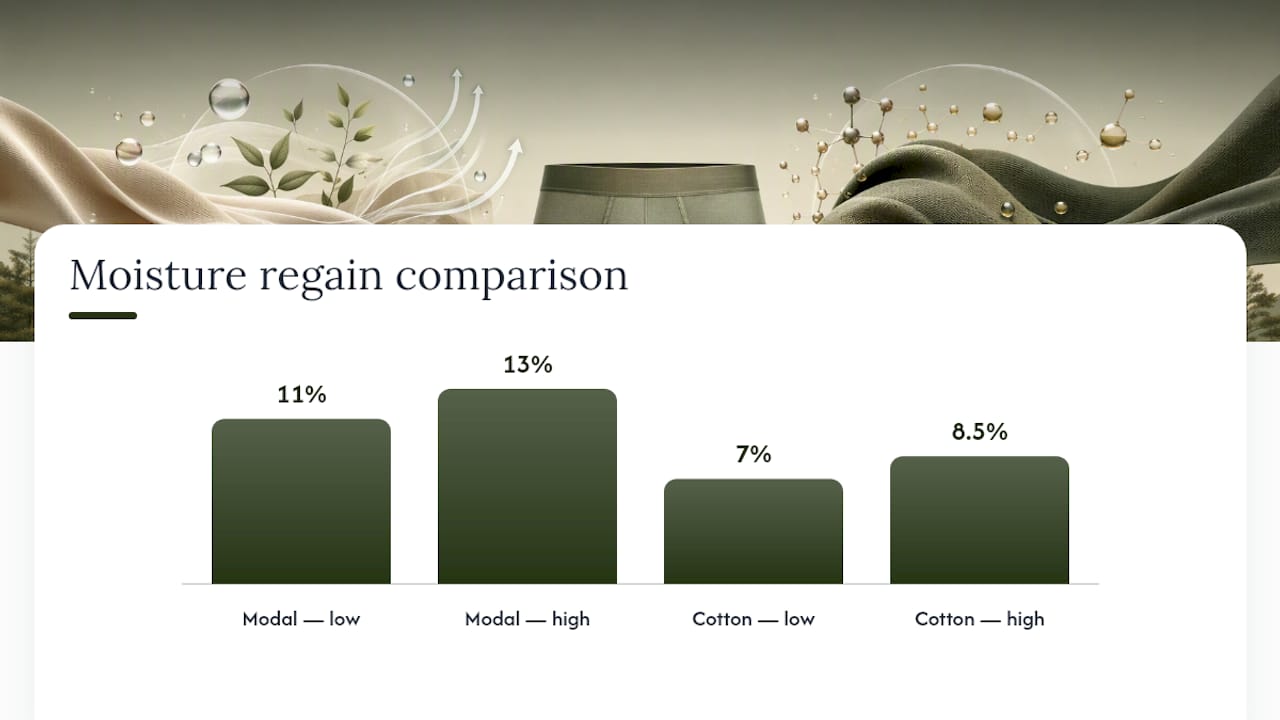
Some brand pages round this up into a claim that modal is noticeably more absorbent than cotton, without assigning a specific percentage. Treat that number skeptically. It shows up often enough to look official, but no consistently cited lab source backs the exact figure, so it’s safer to say modal absorbs noticeably more moisture without pinning it to a precise percentage.
Absorption is only half of breathability, though. The other half is air permeability, which textile labs measure with a standardized method called ASTM D737, essentially forcing air through a fabric sample and timing how fast it passes. Wicking speed, meanwhile, gets measured with tests like AATCC 195. When researchers ran modal and Lyocell through these tests, weave pattern and yarn density changed the results more than fiber type did. In several constructions, Lyocell actually beat modal on permeability and wicking.
Modal’s fiber-level advantages:
- Higher moisture regain than cotton, so sweat gets absorbed rather than sitting on skin
- Smoother fiber surface, which reduces friction and irritation
- Higher wet modulus, meaning it resists stretching and losing shape when damp
None of those traits guarantee more airflow. A modal fiber is good at handling moisture once it’s on the fabric. Whether air can move through that fabric in the first place comes down to how tightly it’s knit.
Modal vs Cotton: Which Wins for Underwear and Sleepwear?
For anything worn directly against skin, the comparison breaks down into five practical categories: perceived coolness, moisture handling, drying speed, odor, and how well the fabric survives repeated wear.
Perceived coolness goes to modal in most equal-weight comparisons, mainly because of that smooth fiber surface and superior moisture buffering. But equal weight is the catch. A heavy modal jersey can trap more warmth than a lightweight cotton percale, so a shopper comparing two garments by fiber name alone can end up picking the warmer one by accident.
Moisture handling favors modal. It absorbs more, buffers sweat better, and resists that stuck-to-skin feeling cotton develops once it’s saturated. Modal is also frequently recommended for next-to-skin layers specifically because it reduces the clammy sensation that heavy cotton produces when it holds water instead of moving it along.
Drying speed tends to favor cotton in lighter weaves, since modal’s higher absorption means it’s holding more water to begin with, which takes longer to evaporate. If you’re packing for travel and need something to dry overnight in a hotel sink, a lightweight cotton piece may win on that single metric even though modal wins on comfort.
Odor retention is roughly a wash between the two on their own, though antimicrobial finishes applied during manufacturing can shift this in either direction, so check the product description rather than assuming based on fiber alone.
Durability and pilling lean toward modal for shape retention, thanks to its wet modulus advantage, but modal alone has weaker natural elastic recovery than cotton with spandex blended in. That’s why most fitted modal underwear includes a small percentage of elastane.
Pro Tip: Check the fabric weight listed in grams per square meter (GSM) before you check the fiber content. A 140 GSM modal jersey and a 220 GSM cotton knit will behave nothing alike, no matter what the tag says about “breathable fibers.”
When you’re shopping, look for lightweight, open-jersey modal, or modal blended with a small amount of elastane for fitted underwear. Both signal a construction built for airflow rather than warmth.
Does Fabric Construction Matter More Than the Fiber Itself?
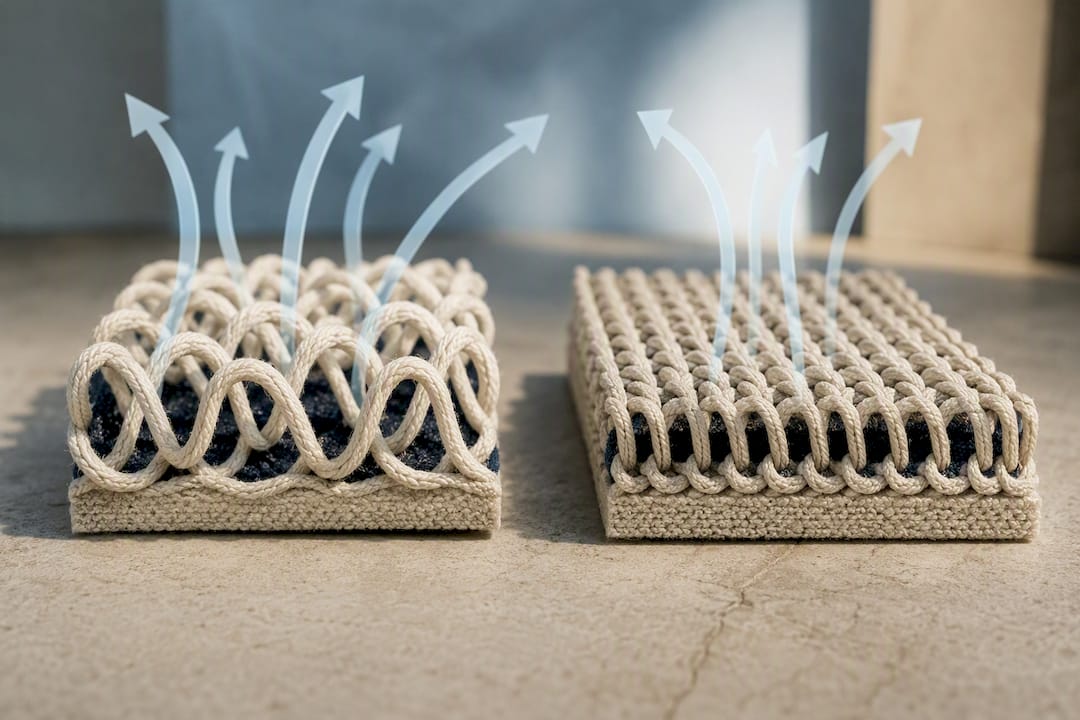
Yes, and it’s not close. Breathability comes from how open or dense a knit or weave is, and that structural choice can override whatever advantage the fiber itself offers. A dense modal knit can measure less air-permeable than a loose cotton weave, which means the “more breathable fiber” doesn’t automatically produce the more breathable garment.
Three things determine how a modal or cotton garment actually performs:
- Fabric weight (GSM). Lightweight modal for underwear and sleepwear typically falls in the 140 to 160 GSM range. Anything heavier starts trading airflow for warmth and structure.
- Knit or weave type. Open jersey and percale weaves let air move through the fabric. Sateen weaves and heavy jersey knits pack fibers tighter, which improves drape and durability but restricts ventilation.
- Blend composition. Modal often gets blended with a small amount of elastane, since modal alone lacks strong natural stretch recovery. The trade-off is a slightly denser fabric structure, though the fit improvement usually outweighs the minor breathability cost for fitted pieces like underwear.
Pro Tip: If a product listing mentions GSM and describes the knit as “open jersey” or “lightweight,” that’s a stronger breathability signal than any marketing language about the fiber itself. Ask the retailer directly if the listing doesn’t specify.
This is also where lab data gets interesting: the same ASTM D737 air-permeability test can reverse the winner entirely once you change the weave. A fiber that “loses” to cotton on paper can win in practice if it’s knit more openly.
How Do You Care for Modal Without Ruining Its Feel?
Modal holds up well over time, but it rewards a gentler laundry routine than cotton tolerates. Wash it cold, skip harsh detergents, and air-dry when you can.
- Cold water wash cycles protect the fiber structure and reduce shrinkage over repeated washes.
- Mild detergent avoids breaking down the smooth fiber surface that gives modal its soft hand.
- Air-drying or low heat preserves shape, since high heat is the main way modal garments lose their fit over time.
- Avoid overloading the washer, since friction against other garments is the primary driver of pilling.
Modal’s high wet modulus means it keeps its shape better when wet than older viscose rayon fabrics did, a real improvement in dimensional stability after washing. That said, blends and knit type still swing the outcome. A modal and elastane blend in a tight knit will resist stretching out better than pure modal in a loose jersey, so read the fabric content alongside the care label, not instead of it.
When Should You Choose Modal Over Cotton?
Match the fiber to the job rather than picking one as a universal winner.
Modal makes the most sense for:
- Underwear, slips, and camisoles worn directly against skin all day
- Sleepwear, especially for people who run warm or wake up sweaty
- Light base layers where moisture buffering matters more than rapid drying
Cotton makes more sense for:
- Heavier daily wear that needs to survive rough handling
- Items where fast drying and low-fuss care outrank next-to-skin softness
- Situations where you need a fabric that dries overnight, like travel packing
Hot sleepers tend to prefer modal specifically because it absorbs sweat rather than letting it sit on skin. If you’re deciding between the two for a sleepwear upgrade, modal’s moisture handling is the deciding factor more often than raw airflow.
Is Modal Fabric Environmentally Friendly?
Modal starts as wood pulp, usually from beech trees, but turning that pulp into fiber requires chemical processing that varies a lot in how responsibly it’s handled. Some manufacturers run closed-loop systems that recapture and reuse the solvents involved. Others don’t, and the resulting environmental footprint differs enormously between the two approaches even though the finished fabric looks identical on a store shelf.
That gap is why generic “eco-friendly” language on a product page tells you almost nothing. Look instead for specifics: does the brand name its pulp source, disclose its processing method, or reference a third-party certification rather than just using the word “sustainable”?
What to check before buying:
- Does the brand name the source forest or wood pulp supplier?
- Is there a mention of closed-loop or low-impact processing?
- Are there third-party certifications, not just marketing copy?
- Does the page distinguish between recycled content and virgin fiber?
Resources like The Cork Store’s guide to spotting sustainable materials offer a useful framework for separating genuine transparency from vague sustainability claims, and the same checklist applies whether you’re shopping for modal, cotton, or anything in between.
Breevar’s Take on Breathable Sleepwear
Breevar builds its sleepwear and underwear around hemp and linen instead of modal, and that choice comes from the same logic covered above: construction and fiber choice both matter, and different fibers solve different heat problems.
Hemp prioritizes airflow, thanks to its naturally porous fiber structure, which is why the Men’s Short-Sleeve Hemp Sleepwear Set works well for people who overheat overnight. Linen leans into cooling through its looser weave and quick heat dissipation, making the Men’s Short-Sleeve Linen Sleepwear a strong pick when ventilation matters more than anything else. For couples shopping together, the Hemp Lovers’ Sleepwear Set for 2 applies that same airflow priority to a shared gift.
None of these fibers are interchangeable. If moisture buffering against skin is your top priority, modal underwear still earns its reputation. If nighttime overheating is the problem you’re solving, hemp and linen tackle it from the ventilation side rather than the absorption side.
— Jason
Ready to Try Breathable Natural Sleepwear?
If you’ve read this far weighing modal against cotton, you already know the real question isn’t which fiber sounds more advanced. It’s which one solves the specific problem keeping you up at night: sweat that won’t wick away, or heat that won’t escape. Breevar builds around the second problem, using hemp and linen to move air rather than just absorb moisture.

The Men’s Short-Sleeve Hemp Sleepwear Set gives hot sleepers a porous, breathable option for nightly wear. The Men’s Short-Sleeve Linen Sleepwear leans harder into cooling for anyone whose main complaint is overheating rather than sweating. And the Hemp Lovers’ Sleepwear Set for 2 turns that same comfort into a gift for two, with every purchase supporting ongoing climate and social responsibility partnerships. Browse the current sleepwear lineup and find the fit that matches how you actually sleep.
Sources
- What Is Modal? — The Good Trade
- What is modal fabric? — HowStuffWorks
- Breathability of fabrics and fibers — Fulgar
FAQ
What Are the Disadvantages of Modal Fabric?
Modal can be slower to dry than lightweight cotton because it absorbs more moisture, and pure modal without elastane can stretch out of shape over time in loose knits. Processing methods also vary widely between suppliers, so environmental impact isn’t consistent across every modal product.
What Breathes Better, Cotton or Modal?
Neither wins outright. Modal generally handles moisture better and feels cooler against skin at equal fabric weight, but a loose cotton weave can outperform a dense modal knit on raw airflow, so construction decides the winner more than fiber choice does.
Is Modal Fabric Good for Hot Weather?
Lightweight modal in an open knit works well in warm conditions because it absorbs sweat without feeling wet, but heavier modal constructions can trap heat, so check the GSM and knit type before assuming any modal garment is automatically cooling.
Is Modal as Healthy to Wear as Cotton?
Modal’s smooth fiber surface tends to cause less friction and irritation than cotton, and its moisture buffering reduces the damp, clammy feel linked to skin irritation in humid conditions. Neither fiber poses a known health risk when worn as finished fabric, though people with sensitivities to fabric processing chemicals should look for suppliers who disclose their manufacturing methods.


Leave a comment