


Organic vs Natural Fabrics: 60 Second Checks for Underwear & Sleepwear
“Natural” tells you where a fiber came from. “Organic” tells you how it was grown and processed, and it’s the only one of the two that’s actually verified. If chemical exposure and fair processing matter to you, prioritize items carrying GOTS certification over anything simply labeled “natural.” Some brands build their sleepwear and underwear around that exact distinction, like this unisex organic raglan sweatshirt that demonstrates certified-organic apparel in practice.
TL;DR:
- The label “natural” only indicates fiber origin and can still involve heavy chemical treatments, making it unreliable for safety or sustainability.
- GOTS certification verifies the entire supply chain, ensuring organic farming, safe processing, and banning harmful chemicals, unlike general “organic” labels.
- Organic cotton significantly reduces pesticide use, which benefits skin health and environmental impact, especially in sleepwear or underwear worn close to sensitive skin.
- Many natural fibers like hemp and linen have low-input farming practices, but certification adds value by controlling chemical use during dyeing and finishing stages.
- Since organic fabrics are more expensive due to lower yields and strict processing, buyers should prioritize verified certification and proper care to maximize their benefits.
Table of Contents
- Organic vs Natural Fabrics: The Core Difference
- What Does “Organic” Actually Mean for Fabric?
- Common Natural Fibers and Where Organic Versions Exist
- How Processing Turns “Natural” Into Something Else
- How to Verify Organic Claims Before You Buy
- Weighing the Tradeoffs: Health, Environment, and Cost
- Choosing and Caring for Underwear and Sleepwear Fabrics
- Who Made Your Fabric, and Under What Conditions?
- Why Organic Fabrics Usually Cost More
- An Editor’s Take on Chasing “Natural” Labels
- Breevar’s Picks for Natural, Certification-Minded Sleepwear
- Sources
- FAQ
Organic vs Natural Fabrics: The Core Difference
“Natural” is a claim about origin. It means a fiber grew from a plant or came from an animal instead of a petroleum refinery. Cotton, linen, wool, silk, and hemp are all natural fibers. So is bamboo, technically, though the way it’s usually processed into rayon strips out most of what made it “natural” in the first place.
Here’s the catch: no U.S. regulation defines what “natural” means on a clothing tag. The Textile Fiber Products Identification Act, enforced by the FTC, requires brands to disclose generic fiber names and percentages by weight. It says nothing about pesticides, dyes, or finishing chemicals. A shirt can legally say “100% natural cotton” even if that cotton was grown with heavy pesticide use and then bleached, dyed, and treated with synthetic resins.
That gap creates real confusion at the shelf. A few common examples:
- Superwash wool is coated in a thin plastic resin so it survives a washing machine. It’s still “natural” wool by fiber content, but it’s no longer just wool.
- Easy-care or wrinkle-resistant cotton is often treated with formaldehyde-based resins to hold its shape.
- Water-repellent or stain-resistant finishes on “natural” linen or cotton sometimes involve PFAS chemicals, the same family under scrutiny in nonstick cookware.
As one comparison of organic and conventional cotton puts it, “natural” refers to the source of the fiber, while “organic” refers to how it was grown and processed. A 100% natural garment can still carry a full chemical history. That’s the whole reason certification exists.
What Does “Organic” Actually Mean for Fabric?
“Organic” starts at the farm. It refers to agricultural standards: no synthetic pesticides, no genetically modified seed, and specific soil and crop-rotation practices. But farm-level organic certification alone doesn’t tell you anything about what happened to that fiber after harvest, and that’s where most of the meaningful risk in textiles actually lives.
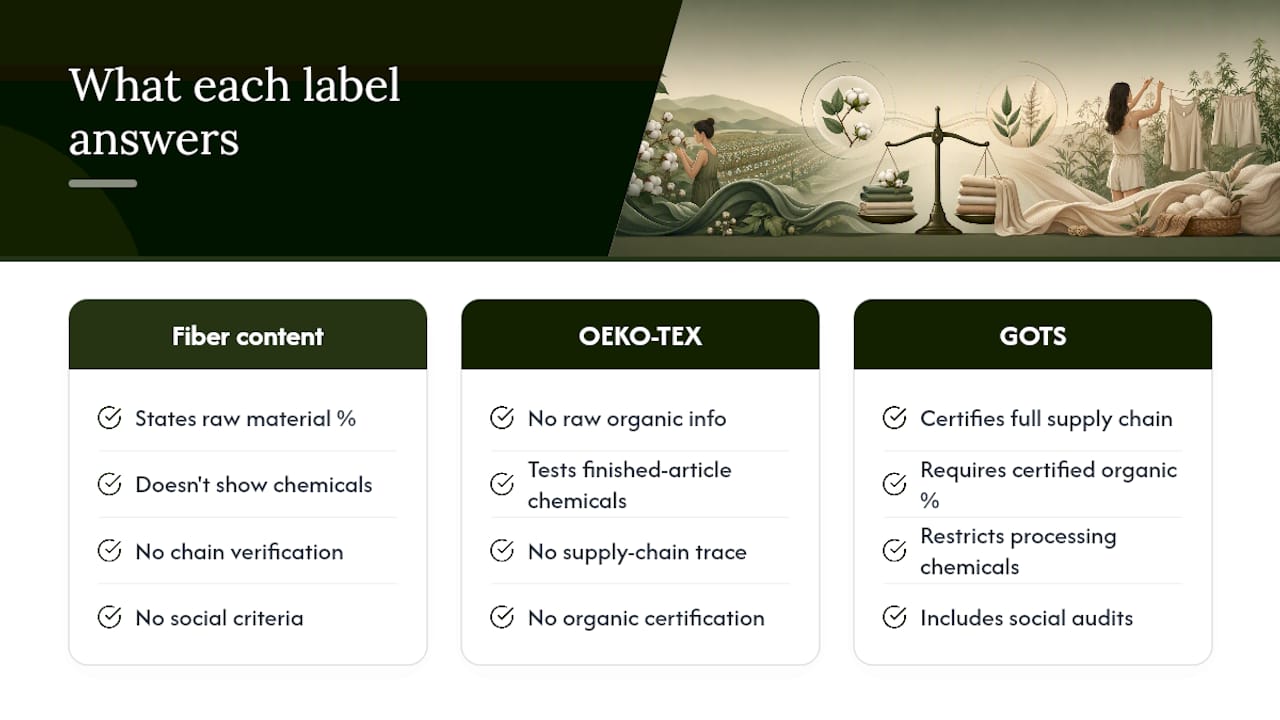
This is why the Global Organic Textile Standard, or GOTS, matters more than the word “organic” by itself. GOTS certifies the entire supply chain, not just the field.
GOTS-labeled goods require a high percentage of certified organic fibers, and products carrying the “organic” grade require an even higher proportion. The standard follows the fiber through spinning, dyeing, and finishing, tracks chain-of-custody at every stage, and includes social criteria plus on-site facility inspections.
That last part is the piece most shoppers miss. GOTS doesn’t just check a box for the raw fiber. It restricts specific processing inputs, too, including a ban on chlorine-based descaling for wool and limits on synthetic sizing agents, all verified through audits at each production stage.
Compare that to a fiber-content label or a testing mark like OEKO-TEX Standard 100. A fiber-content label just states the raw material by percentage. It doesn’t tell you what chemicals touched the fabric on its way to becoming a shirt. OEKO-TEX tests the finished article for harmful substances above defined thresholds, and it applies to synthetic and natural fibers alike, but it says nothing about whether the fiber was grown organically. Each mark answers a different question. GOTS is currently the only one answering all of them at once, which is exactly why organic-integrity advocates treat it as the benchmark for full-chain verification.
Common Natural Fibers and Where Organic Versions Exist
Not every natural fiber has a mature organic market, and the differences matter once you’re shopping for something that touches your skin all night.
Cotton is the fiber where organic versus conventional matters most, because conventional cotton is one of the most pesticide-intensive crops grown anywhere. Research comparing the two finds that organic cotton production can reduce pesticide use and some environmental impacts, though the net benefit depends heavily on yield, water source, and regional farming practices. For underwear specifically, that pesticide reduction is worth caring about since the fabric sits against sensitive skin for hours at a time.
Linen (flax) and hemp are naturally low-input crops. Both typically need less water and fewer pesticides than conventional cotton even without certification, and both fibers are prized for breathability and durability. Organic certification still adds value here by covering the dyeing and finishing stages, where most of the residual chemistry actually gets introduced. Breevar’s own comparison of hemp versus cotton breaks down why hemp in particular holds up so well for hot sleepers.
Wool and silk raise different questions, mostly around animal welfare and land use rather than pesticide exposure. Look for the Responsible Wool Standard for sourcing assurances, and know that GOTS applies to wool and silk textiles too, once they’re processed and blended into finished goods.
A quick fit check for underwear and sleepwear:
- Cotton: soft, absorbent, best organic when next to skin daily.
- Linen: breathable, cools fast, wrinkles easily, holds up for decades.
- Hemp: highly breathable, naturally moisture-wicking, gets softer with wash.
- Wool: warm, odor-resistant, needs animal-welfare sourcing checks.
- Silk: smooth and temperature-regulating, but delicate and higher maintenance.
How Processing Turns “Natural” Into Something Else
Raw fiber is only the beginning of a textile’s life. Between the field and the folded shirt on a shelf, fabric passes through a chain of wet-processing stages, and each one is a point where synthetic chemistry can enter a product still marketed as “natural.”
A simplified version of that chain looks like this:
- Sizing: a coating applied to yarn to help it survive weaving, often synthetic unless specified otherwise.
- Desizing and bleaching: chemical baths that strip that coating and lighten the fiber.
- Dyeing: where heavy-metal-based colorants or allergenic dyes can appear if unregulated.
- Finishing: the stage where resins, softeners, or repellent coatings get added.
Reviews of textile-processing chemistry note that hazardous substances can persist through these stages, and that better standards and testing reduce, but don’t fully eliminate, that risk.
Pro Tip: If a natural-fiber garment claims to be machine-washable, wrinkle-free, or stain-resistant, that’s often a signal a finish was applied. It’s not automatically bad, but it’s worth checking the certification before assuming “natural” means untreated.
How to Verify Organic Claims Before You Buy
Checking a garment’s real fiber story takes about sixty seconds once you know what to look for.
- Read the fiber-content percentage first. A tag reading “95% organic cotton, 5% elastane” tells you more than any marketing copy on the product page.
- Look for a GOTS label and note its grade. “Organic” grade means 95% or more certified organic fiber; the standard “made with organic” grade means at least 70%.
- Check for a testing mark like OEKO-TEX if GOTS isn’t listed. It won’t confirm organic farming, but it does confirm the finished fabric was screened for harmful substances.
- Ask about finishes. Brand pages or customer service should be able to tell you whether a garment was treated with superwash, water-repellent, or easy-care coatings.
| Priority | What it confirms | Where to check |
|---|---|---|
| Fiber content | What the garment is actually made of | Sewn-in tag, product page |
| GOTS certification | Organic farming plus safe processing chain | Product page, hang tag |
| OEKO-TEX or similar | Finished fabric tested for harmful substances | Hang tag, brand certifications page |
| Finish disclosure | Whether coatings or resins were added | Product description, customer service |
For underwear and sleepwear, that order of priority (fiber, then certification, then finish) is the fastest way to filter out garments that look clean but aren’t.
Weighing the Tradeoffs: Health, Environment, and Cost
Natural fibers biodegrade, breathe, and generally skip the microplastic problem synthetics carry. Certified organic textiles add pesticide reduction, safer dye chemistry, and verified labor standards on top of that. Those are real advantages, and they’re the reason GOTS-labeled goods often cost more.
The tradeoffs run the other way too. Organic-certified items usually cost more and can be harder to find in every style. Untreated natural fabric without any finish can wrinkle, shrink, or wear out faster without care. And blends deserve a specific warning: even a small percentage of synthetic fiber mixed into an otherwise natural fabric means the garment sheds microplastic fibers in the wash and loses full biodegradability. A “95% cotton, 5% spandex” sock is not a natural-fiber sock once it hits the washing machine.
Choosing and Caring for Underwear and Sleepwear Fabrics
Underwear and sleepwear sit against skin for hours, so breathability and moisture-wicking matter more here than almost anywhere else in your closet. Organic cotton, linen, and hemp all perform well for that job, and hemp in particular resists odor buildup better than most synthetics.
Insist on GOTS when you’re buying something that touches sensitive skin daily, especially for babies, people with eczema, or anyone prone to skin irritation. OEKO-TEX or clear brand transparency about sourcing can be a reasonable middle ground when GOTS isn’t available for a specific style.
- Wash organic and natural-fiber underwear in cool or warm water, never hot, to protect fiber integrity.
- Skip fabric softener on moisture-wicking fabrics; it coats fibers and blocks breathability.
- Avoid dry-cleaning anything with a natural-fiber claim, since the solvents used can strip or alter finishes.
- Air-dry when possible to extend elastic and seam life.
Pro Tip: Check the care tag before the sales pitch. A garment that says “cold wash only, no fabric softener” is usually telling you it wasn’t treated with heavy synthetic finishes, which is a good sign for both your skin and the planet.
Who Made Your Fabric, and Under What Conditions?
Fiber origin and chemical safety get most of the attention in sustainability conversations, but the labor behind a garment deserves equal weight. This is one of the sharpest, least understood differences between “natural” and “organic” claims.
A “natural” label carries zero labor requirements. A cotton farm can grow fiber without synthetic pesticides and still operate under poor wage conditions or unsafe working environments; nothing about the word “natural” touches that question at all.
GOTS is different by design. Its certification includes social criteria covering fair wages, safe working conditions, and freedom from forced or child labor, verified through the same on-site audits that check chemical inputs. That’s not a marketing add-on. It’s built into the standard’s structure, which is part of why GOTS certification takes real investment for a brand to earn and maintain.
This is also where organic cotton’s story gets more interesting than “fewer pesticides.” Farming without synthetic chemical inputs often changes the relationship between farmworkers and the crop itself, since workers aren’t handling the same volume of chemical sprays during the growing season. That’s a real health benefit for the people growing your clothes, not just an environmental one for the water table.
If labor conditions matter to you as much as chemical safety, a “natural” tag alone tells you nothing. A GOTS certification, or clear brand-level transparency about sourcing relationships, is the closest thing to a verified answer currently available.
Why Organic Fabrics Usually Cost More
Organic-certified textiles typically run higher in price than conventional natural-fiber equivalents, and the reasons trace directly back to the standards behind the certification, not just marketing markup.
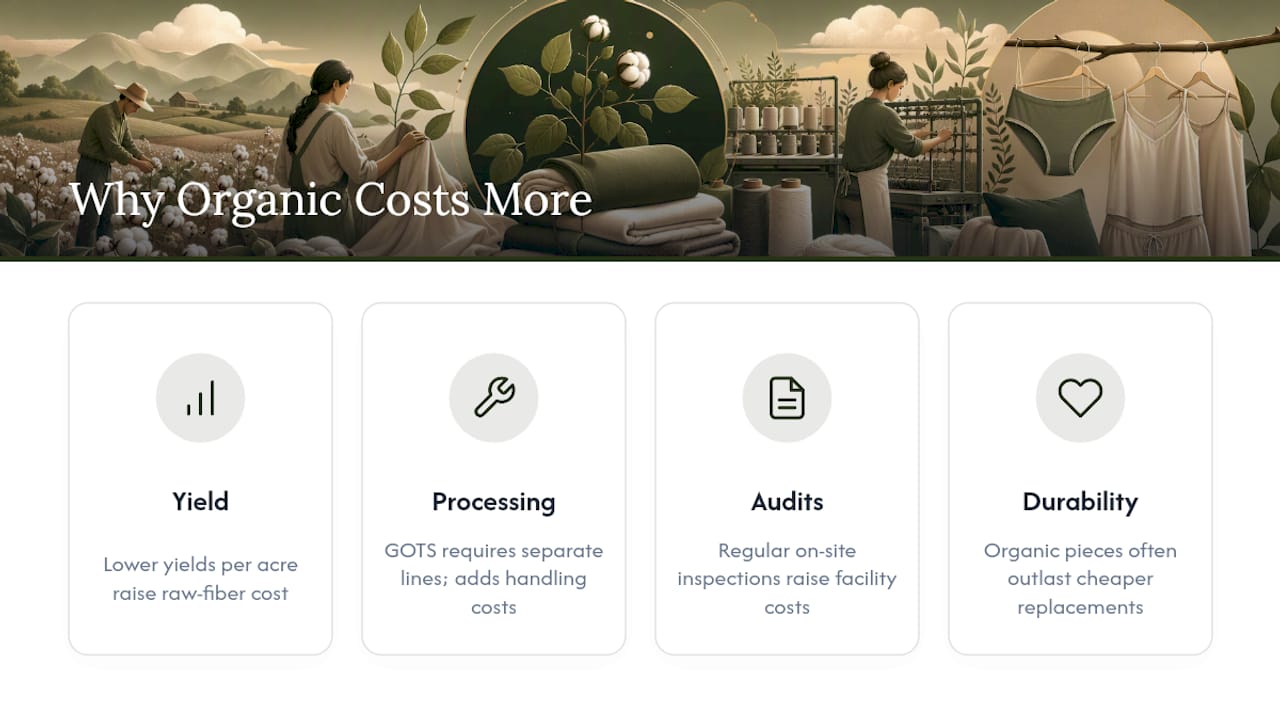
Organic farming tends to produce lower yields per acre than conventional farming, since it skips synthetic fertilizers and pesticides that boost output. Lower yield per acre means higher cost per pound of raw fiber before a single thread gets woven. Add GOTS chain-of-custody requirements, which force separate processing lines to keep organic fiber from mixing with conventional fiber, and you’re looking at added handling costs at every stage from spinning to dyeing.
Audits cost money too. A GOTS-certified facility pays for regular on-site inspections covering both chemical inputs and labor conditions, and that cost gets absorbed somewhere in the final price. None of that is unique to fabric. It’s the same reason organic produce costs more at the grocery store than conventional produce.
The price gap tends to be smaller for naturally low-input fibers like hemp and linen, since the growing practices are already close to organic standards even without formal certification. Cotton shows the widest gap, since conventional cotton farming leans hardest on the synthetic inputs organic certification removes.
For underwear and sleepwear specifically, the higher upfront cost of a certified item is worth weighing against how often you’ll wear it. A well-made organic cotton or hemp piece with proper care can outlast several cheaper conventional pieces bought to replace worn-out ones.
An Editor’s Take on Chasing “Natural” Labels
Most sustainability advice tells shoppers to “buy natural” as if that solves the problem. It doesn’t. The word “natural” has no enforceable definition on a hang tag, which means it’s functionally meaningless as a safety or sustainability signal on its own. Certification is the only piece of this puzzle doing real verified work.
What gets underestimated is how much of the risk in “natural” textiles lives in the finishing stage, not the fiber itself. A resin coating or a PFAS-based repellent can undo most of the benefit a shopper thought they were getting from choosing cotton over polyester in the first place.
Some brands’ approach starts from that label-literacy standpoint: prioritize verified natural materials like hemp and linen, focus on moisture-wicking performance for people who overheat at night, and choose sourcing that can actually be explained rather than just claimed. A curated gift set built around that logic, with a portion of every purchase supporting climate and social initiatives, may do more for a shopper’s actual goals than any garment simply stamped “natural” ever could.
— Jason
Breevar’s Picks for Natural, Certification-Minded Sleepwear
If everything above left you wanting fewer decisions and more straightforward choices, Certain product lineups are built around exactly that logic: natural fibers first, verified sourcing, and no mystery finishes.
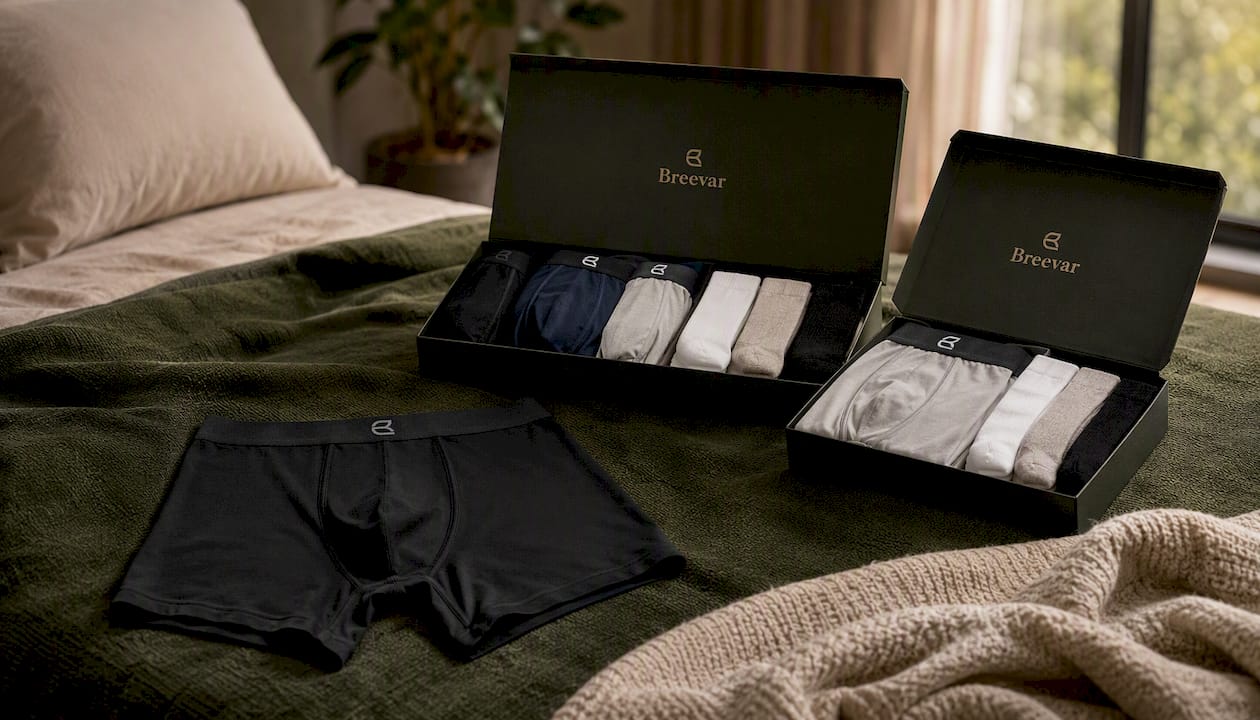
The Naturally Better Underwear & Socks Essentials Gift Box pairs breathable natural-fabric underwear with matching socks, built for anyone who wants an easy, no-guesswork switch away from synthetic basics. Want a bigger upgrade for yourself or someone else? The Naturally Better Underwear & Socks Deluxe Gift Box expands that same natural-fiber lineup into a fuller set, ideal for gifting during a holiday or just replacing an entire drawer at once. And if modal’s smooth, moisture-wicking feel is what you’re after specifically for sleep, the Men’s Modal Performance Long Boxer Brief is built for exactly that: breathable coverage that holds up through a hot night without overheating.
Every purchase may support climate and social initiatives, so the upgrade does more than sit in a drawer looking sustainable. Browse current product lineups and pick the set that matches how you sleep.
Sources
- Global Organic Textile Standard (GOTS) — How it works
- NCBI article on textile chemical exposures and environmental/health concerns
- Understanding fabric labels: what ‘100% natural fiber’ really means
- Study: Organic cotton production may alleviate environmental impacts
FAQ
What’s the Healthiest Fabric to Wear?
Certified organic natural fibers like GOTS-certified cotton, linen, and hemp tend to be the safest choice for skin contact, since they skip synthetic pesticide residue and undergo restricted, tested processing chemistry.
What Are the Downsides of Organic Cotton Fabric?
Organic cotton typically costs more due to lower farming yields and stricter processing requirements, and it can be harder to find in every style or size compared to conventional cotton.
Which Fabrics Are 100% Natural?
Cotton, linen, hemp, wool, and silk are naturally sourced fibers, but a fabric is only fully natural in practice if it hasn’t been treated with synthetic finishes like resin coatings or water-repellent chemistry.
Is It Healthier to Wear Natural Fibers?
Natural fibers generally breathe better and avoid the microplastic shedding synthetic blends cause, but “healthier” depends on processing too. A GOTS-certified natural fiber garment offers more verified safety than one simply labeled “natural” with no certification behind it.


Leave a comment