

Sleep Socks vs Regular Socks: What Actually Differs
The difference between sleep socks and regular socks is mostly fit and fabric, not a special technology. A good pair for bed is loose, soft and made from a breathable fiber, with no tight band at the cuff. A regular sock is built to stay put inside a shoe, so it often grips, compresses and traps heat. If you run warm at night, fabric matters more than the label. That is why we make our socks and sleepwear from natural, moisture-wicking materials like hemp, linen and modal.
TL;DR
- Sleep socks are defined by what they leave out: tight elastic, thick seams and heat-trapping synthetic fabric. Any sock with those traits works as one.
- Warming your feet widens blood vessels and helps your body release heat. In one small study, people wearing bed socks fell asleep about 7.5 minutes faster and slept about 32 minutes longer.
- If you get night sweats, choose breathable, moisture-wicking natural fibers and a loose cuff. Avoid compression socks in bed unless a doctor prescribed them.
- Wear a fresh, clean pair every night, not the pair you wore all day.
Table of Contents
- What counts as a sleep sock?
- Sleep socks vs regular socks, side by side
- Why warm feet help you fall asleep
- The warm-but-not-sweaty problem
- What to avoid in bed
- Do your feet need to breathe at night?
- How to choose your pair in four checks
- A budget view: one pair, many nights
- Our perspective
- Build your sleep set with Breevar
- FAQ
- Sources
What counts as a sleep sock?
There is no regulated category called “sleep socks.” The term describes a pair chosen for lying down instead of walking. That changes the design priorities.
A regular everyday sock is made to take friction, cushion your heel and stay up inside a shoe. It usually has a snug elastic cuff and reinforced zones at the heel and toe. An athletic or work sock can be thick, dense and sometimes synthetic, because it has to manage sweat during movement.

A sock for bed has a different job: keep the feet gently warm without squeezing them or holding in moisture. Doctors who write about the habit describe the same traits. Cleveland Clinic’s Dr. Aparna Bhat recommends breathable, loose-fitting socks in cotton, merino wool, bamboo or viscose, and says polyester is less ideal. A Kaiser Permanente sleep specialist quoted by Woman’s World points to loose, breathable, moisture-wicking materials, no tight elastic bands, ankle or crew length, and a fresh pair each night.
Sleep socks vs regular socks, side by side
| Feature | Typical regular sock | Good sock for sleeping |
|---|---|---|
| Cuff | Snug elastic to stay up in a shoe | Loose, non-binding, leaves no marks |
| Fabric | Often a synthetic blend, sometimes thick cotton | Breathable natural fibers that move moisture away |
| Thickness | Cushioned for walking | Light to medium, matched to your room temperature |
| Seams | Can be bulky at the toe | Flat or seamless so nothing presses while you lie on it |
| Length | Any, including no-show or knee-high | Ankle or crew |
| Purpose | Protect feet inside shoes | Keep feet comfortably warm in bed |
The table shows why a plain pair from your drawer can feel fine or terrible at 3 a.m. If the cuff leaves a red ring on your ankle, or the fabric feels damp by morning, it is acting like a regular sock in a place it was not designed for.
Why warm feet help you fall asleep
Your body has to shed heat to fall asleep. Warming the feet widens the blood vessels in them, a process called distal vasodilation. That lets heat leave through the skin, and Cleveland Clinic explains that this lowers core temperature, the signal your body associates with sleep.
A 2018 study in the Journal of Physiological Anthropology tested this with bed socks. Six young men slept seven hours in a 23°C (73°F) room, with and without socks. With socks, they fell asleep 7.5 minutes sooner, slept 32 minutes longer and woke 7.5 times less often (8.8 awakenings versus 16.3). Sleep efficiency rose from 86.2% to 93.8%, and foot temperature was 1.3°C higher.

The authors are clear about the scale: six young men in a cool room. They call for larger studies that include older people and women. An earlier Dutch study found that in adults, warm and neutral bed socks sped up sleep onset in proportion to how much the feet warmed.
So the honest reading is practical rather than miraculous. A sock that warms your feet comfortably is a low-risk way to help your body make the transition to sleep, and Dr. Mathur describes it as likely most useful for people whose feet are truly cold. Sleep specialist Dr. Atul Malhotra of UC San Diego told Snopes that how much socks help varies by person and climate.
The warm-but-not-sweaty problem
This is where the sleep sock question gets personal. Cold-footed sleepers want warmth. Hot sleepers and people with night sweats want to avoid trapping heat. The same sock cannot be warm and breathable unless the fabric does the work.
Here is what to look at.
Fiber
Northwell Health sleep physician Dr. Gary Wohlberg says natural-fiber socks such as cotton, cashmere and wool suit warmth and breathability, while polyester can trap moisture and bacteria. The Sleep Foundation notes that cashmere or merino wool socks allow heat to build up and escape in adequate amounts. If you are weighing wool for the rest of your bed, a guide to merino wool bedding shows how the same fiber behaves in blankets and toppers.
Wool is not the only option. Hemp, linen and modal are plant-based fibers valued for airflow, and they are the materials we use across our range. Our fabrics are moisture-wicking, so sweat is pulled away from skin instead of sitting against it. For a deeper look at fibers for hot sleepers, see our guide to fabrics for night sweats, or compare hemp and merino for sleep.
Weight
A thick wool sock that is perfect for a drafty bedroom in January can be too much in a heated apartment. Match the sock to the room: lighter fabric for warm rooms and summer, heavier for cold bedrooms. Our piece on breathable winter pajamas covers how to stay warm without overheating when the temperature drops.
Construction
Seams you can feel through a sock are a nuisance when you lie on your side. We build our products with seamless, anti-chafe construction so there is less rubbing against the skin. A sock with a loose cuff and flat seams reads as invisible, which is what you want in bed.
What to avoid in bed
Compression socks. These are designed for daytime, when you are upright and gravity pulls blood toward your feet. Dr. Bhat says that when you lie down they can cause blisters, skin irritation, ulceration and restricted blood flow, so ask your provider before sleeping in them. Northwell’s Dr. Wohlberg likewise advises against them at night unless prescribed.
Tight cuffs. The one thing to watch for in a sock is elastic that leaves marks. Dr. Craig Zebuda told Real Simple, as reported by Woman’s World, that sleeping in socks is safe for most healthy adults, and that the two issues are tight socks and sweaty feet with trapped moisture, which can irritate skin.
Circulation or swelling concerns. The Sleep Foundation advises talking with a doctor before sleeping in socks if you have circulatory issues or swelling in your feet.
Yesterday’s socks. This one is simple. The Healthy reports that wearing the same pair for 24 hours can cause moisture buildup, bacteria and odor. Podiatrist Wenjay Sung, DPM, says sleeping in socks is fine as long as the pair is fresh and clean. So put on a clean pair at bedtime, not the ones you wore through the day.
Do your feet need to breathe at night?
Some podiatrists say that going sockless for eight hours is a chance for feet to air out. Dr. Bhat says going barefoot is fine as well. Northwell’s Dr. Wohlberg points out that you can get the same vasodilation effect from a warm shower or bath before bed, then keep your socks off. Neither choice is wrong, and your own sleep pattern decides.
A practical middle path: if your feet are cold when you get into bed, wear a loose, breathable pair. If you wake up hot, kick them off, and choose a lighter fiber next time. Because a natural, moisture-wicking pair stays comfortable in either case, you don’t have to commit to one answer for every season.
How to choose your pair in four checks
- Cuff. Pull it over your hand. If it squeezes your wrist, it will squeeze your ankle for eight hours.
- Fiber. Choose a natural, breathable fiber. Hot sleepers should lean toward lighter, airy fabrics; cold sleepers can go warmer.
- Seams. Run a finger along the toe seam. If you feel a ridge, you will feel it in bed too.
- Quantity. Own enough pairs to put on a fresh one every night. Changing socks once a day is usually enough, and more often if you sweat heavily, according to The Healthy’s podiatrist source.
For the rest of the bed, the same logic applies. Cooling bedding and sleepwear work together, and our comparison of cooling sheets and pajamas shows which matters most for hot sleepers. If you want the full picture on socks specifically, our article on wearing socks to bed goes further.
A budget view: one pair, many nights
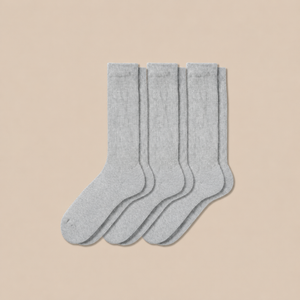
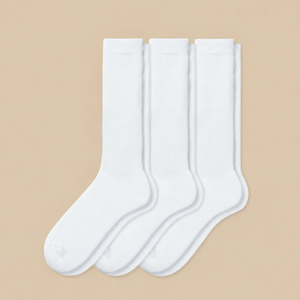
A sock bought only for sleeping sits in a drawer for the hours you are awake. A pair you like in natural fiber can do double duty: lounging at home in the evening, then bed. Since you should wear a clean pair each night, a small rotation is what actually counts. Our subscription purchase option can suit a rotation you want replenished, and our products come as one-time buys as well. The 3-pack format is also an easy way to build that rotation, for example the 3-pack men’s 3D sports crew socks.
Our perspective
We started from a simple observation: the people who struggle most with sleep temperature are not asking for gadgets. They want fabrics that behave. Warm feet help many people drift off, but the same feet can overheat if the fabric holds moisture, so the question is never socks or no socks. It is what the sock is made of and how it fits.
That is why we work with natural materials like hemp, linen and modal, in moisture-wicking, seamless, anti-chafe constructions. Our approach is to treat feet, body and bed as one system. A sock that moves sweat away from skin, a loose cut that does not mark your ankle and sleepwear that breathes all point the same direction: a night that does not wake you up too hot or too cold.
It also matters to us where the money goes. Every purchase supports nonprofit initiatives focused on climate action and social responsibility, so choosing comfortable natural fabrics is also a choice you can feel good about. If you are buying for someone else, our personalized monograms and curated gift sets make that choice easy to give.
Jason
Build your sleep set with Breevar
If you want one place to start, browse our socks collection for natural, breathable pairs made for men and women. Pair them with women’s sleepwear, men’s sleepwear or hemp sleepwear, and add a text monogram if the set is a gift.

Women can start with the women’s 3D sports crew socks, and men with the men’s 3D sports crew socks.
FAQ
Are socks good to sleep in?
For most healthy adults, yes. Warm feet help the body release heat, and small studies link bed socks with faster sleep onset and fewer awakenings. Choose a loose, breathable pair and wear a clean one each night.
Is it okay to wear the same socks for two days?
Not for sleeping. A pair worn all day holds moisture and bacteria, which can cause odor and irritation. Podiatrist Wenjay Sung, DPM, says sleeping in socks is fine when the pair is fresh and clean.
Should I let my feet breathe at night?
It is a personal choice. Going barefoot is fine, and a warm shower before bed can create a similar warming effect without socks. If you do wear socks, breathable natural fibers and a loose cuff let your feet stay comfortable.
Can I sleep in compression socks?
Only if your doctor recommends it. Compression socks are designed for daytime, and Cleveland Clinic’s Dr. Bhat says that lying down in them can cause skin problems and restricted blood flow. Ask your provider first.
What are the best socks for night sweats?
Look for breathable, moisture-wicking natural fibers, a loose cuff and flat seams. Merino wool is often recommended, and plant fibers like hemp, linen and modal are the materials we use for airflow and comfort.
Sources
- Sleeping With Socks On: Is It Good or Bad? (Cleveland Clinic)
- Can Wearing Socks Help You Sleep Better? (Cleveland Clinic podcast)
- Effects of feet warming using bed socks on sleep quality (Journal of Physiological Anthropology, 2018)
- Effects of feet warming using bed socks on sleep quality (PubMed Central)
- Skin temperature and sleep-onset latency: changes with age and insomnia (PubMed, 2007)
- Sleep Tips: Why You Should Wear Socks To Bed (Northwell Health)
- Sleeping With Socks On: Can Warm Feet Help You Fall Asleep? (Sleep Foundation)
- Does Sleeping With Socks on Actually Help You Fall Asleep Faster? (Woman’s World)
- Does Wearing Socks to Bed Cool Down the Body for Sleep? (Snopes)
- Here’s What Happens If You Don’t Change Your Socks (The Healthy)


Leave a comment